

Stations: 18 Stations, Lead Wire: Top Wire Entry, Cable Length: 1.5m Cable, Option: DIN Rail Mount w/o DIN Rail
Stations: 18 Stations, Lead Wire: Top Wire Entry, Cable Length: 5.0m Cable, Option: DIN Rail Mount w/o DIN Rail
Stations: 2 Stations, Lead Wire: Side Wire Entry, Cable Length: w/o Cable, Option: DIN Rail Mount w/o DIN Rail
Stations: 8 Stations, Lead Wire: Side Wire Entry, Cable Length: 5.0m Cable, Option: DIN Rail Mount w/o DIN Rail
Stations: 3 Stations, Lead Wire: Top Wire Entry, Cable Length: 3.0m Cable, Option: DIN Rail Mount w/o DIN Rail
Stations: 10 Stations, Lead Wire: Side Wire Entry, Cable Length: 3.0m Cable, Option: DIN Rail Mount w/o DIN Rail
Stations: 16 Stations, Lead Wire: Side Wire Entry, Cable Length: w/o Cable, Option: DIN Rail Mount w/o DIN Rail
Stations: 6 Stations, Lead Wire: Top Wire Entry, Cable Length: w/o Cable, Option: DIN Rail Mount w/o DIN Rail
Stations: 7 Stations, Lead Wire: Side Wire Entry, Cable Length: 1.5m Cable, Option: DIN Rail Mount w/o DIN Rail
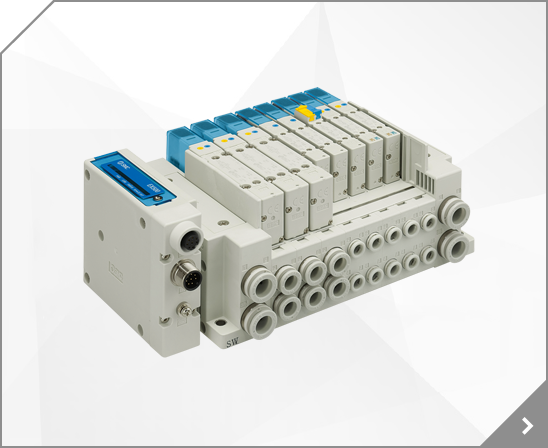
VQ valves are ideal for applications requiring high speed, frequent operation, stable response time and long service life. Innovative mounting methods allow valves to be changed without entirely disassembling the manifold. Built-in one-touch fittings save piping time and labor. "MFLD. 4/5 PORT SOLENOID VALVE. VQ.
 Stroke Reading Cylinder and Counter
 Note) Do not apply rotational torque to the piston rod. 23 m Bore size Allowable rotational torque 12 10 Nm 20 to 32 20 Nm Multi counter CEU5 40 to 63 30 Nm Stroke reading cylinder When using SMC extension cable and counter. Noise Counter Measures Methods of dealing with noise are given below. 1. Connect only the shield wire to FG (frame ground). 2.
Do not use two cylinders facing one another horizontally or vertically in such a way that their piston rods strike each other. 7. When the cylinder head side contains hydraulic fluid or is in a normally pressurized condition, the applied load must not be allowed to strike the piston rod end. Avoid such applications. 8.
Do not use two cylinders facing one another horizontally or vertically in such a way that their piston rods strike each other. 8. When the cylinder head side contains hydraulic fluid or is in a normally pressurized condition, the applied load must not be allowed to strike the piston rod end.
In the case of auto switch rail mounting type, do not remove the rail that is mounted. Because retaining screws extend into the cylinder, this could lead to an air leak.
Do not disassemble, except for when replacing any of the replaceable parts, as this may cause the performance to deteriorate. In the case of a rubber cover, the lock can be released easily by hitting the round tab on the cover with a plastic hammer. 3.
Do not disassemble the power clamp cylinder. The power clamp cylinder consists of a completely sealed structure in order to protect it from welding spatter. Do not disassemble, except for when replacing any of the replaceable parts, as the performance may deteriorate. 10 Power Clamp Cylinder Variations Web Catalog.
Do not operate a cylinder with its bumper bolt removed. If the bumper bolt is removed, the piston hits the head cover, causing damage to the cylinder. Therefore, do not use a cylinder without a bumper bolt. 2. The piston rod must be retracted when mounting the cylinder.
Do not warm the coil assembly with a heat insulator, etc. Use tape, heaters, etc., for freeze prevention on the piping and body only. They can cause the coil to burn out. Caution Direction of mounting 3. Avoid sources of vibration, or adjust the arm from the body to the minimum length so that resonance will not occur.
Do not apply external force to the coil section. When tightening is performed, apply a wrench or other tool to the outside of the piping connection parts. Caution Pilot port piping 12(P1) and 10(P2) piping should be as follows according to the model. 2. Do not warm the coil assembly with a heat insulator, etc. Use tape, heaters, etc., for freeze prevention on the piping and body only.
Do not apply external force to the coil section. When tightening is performed, apply a wrench or other tool to the outside of the piping connection parts. Port Air operated Solenoid 12 (P1) External pilot External pilot 2. Do not warm the coil assembly with a heat insulator, etc. Use tape, heaters, etc., for freeze prevention on the piping and body only.