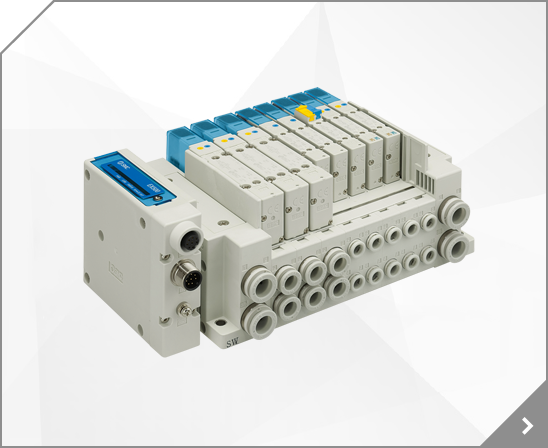


The SV series employs a multi-connector instead of the conventional lead wires for internal manifold wiring. By connecting each block with a connector, changes to manifold stations are greatly simplified. Cassette base type manifolds offer the ultimate in flexibility. Manifold sections can be added using a simple release mechanism.
Body Size: 20, Thread: Rc: Size 20, 25, 30, 40; M5: Size 10, Port Size: 02 (1/4), Option: Standard, Attachment: SV (S + V), Semi-Standard 1: C (Bowl Guard), Semi-Standard 2: Standard
The SV series employs a multi-connector instead of the conventional lead wires for internal manifold wiring. By connecting each block with a connector, changes to manifold stations are greatly simplified. Cassette base type manifolds offer the ultimate in flexibility. Manifold sections can be added using a simple release mechanism.
The SV series employs a multi-connector instead of the conventional lead wires for internal manifold wiring. By connecting each block with a connector, changes to manifold stations are greatly simplified. Cassette base type manifolds offer the ultimate in flexibility. Manifold sections can be added using a simple release mechanism.
The SV series employs a multi-connector instead of the conventional lead wires for internal manifold wiring. By connecting each block with a connector, changes to manifold stations are greatly simplified. Cassette base type manifolds offer the ultimate in flexibility. Manifold sections can be added using a simple release mechanism.
The SV series employs a multi-connector instead of the conventional lead wires for internal manifold wiring. By connecting each block with a connector, changes to manifold stations are greatly simplified. Cassette base type manifolds offer the ultimate in flexibility. Manifold sections can be added using a simple release mechanism.
Body Size: 25, Thread: N (NPT), Port Size: 02 (1/4), Option: Standard, Attachment: SV (S + V), Semi-Standard 1: Standard, Semi-Standard 2: RZ (R + Z)
The SV series employs a multi-connector instead of the conventional lead wires for internal manifold wiring. By connecting each block with a connector, changes to manifold stations are greatly simplified. Cassette base type manifolds offer the ultimate in flexibility. Manifold sections can be added using a simple release mechanism.
Body Size: 50, Thread: Rc, Port: 06 (3/4), Option: DG (D + G), Attachment: SV (S + V), Semi-Standard 1: Standard, Semi-Standard 2: Standard
The SV series employs a multi-connector instead of the conventional lead wires for internal manifold wiring. By connecting each block with a connector, changes to manifold stations are greatly simplified. Cassette base type manifolds offer the ultimate in flexibility. Manifold sections can be added using a simple release mechanism.
The SV series employs a multi-connector instead of the conventional lead wires for internal manifold wiring. By connecting each block with a connector, changes to manifold stations are greatly simplified. Cassette base type manifolds offer the ultimate in flexibility. Manifold sections can be added using a simple release mechanism.
The SV series employs a multi-connector instead of the conventional lead wires for internal manifold wiring. By connecting each block with a connector, changes to manifold stations are greatly simplified. Cassette base type manifolds offer the ultimate in flexibility. Manifold sections can be added using a simple release mechanism.
The SV series employs a multi-connector instead of the conventional lead wires for internal manifold wiring. By connecting each block with a connector, changes to manifold stations are greatly simplified. Cassette base type manifolds offer the ultimate in flexibility. Manifold sections can be added using a simple release mechanism.
The SV series employs a multi-connector instead of the conventional lead wires for internal manifold wiring. By connecting each block with a connector, changes to manifold stations are greatly simplified. Cassette base type manifolds offer the ultimate in flexibility. Manifold sections can be added using a simple release mechanism.
The SV series employs a multi-connector instead of the conventional lead wires for internal manifold wiring. By connecting each block with a connector, changes to manifold stations are greatly simplified. Cassette base type manifolds offer the ultimate in flexibility. Manifold sections can be added using a simple release mechanism.
The SV series employs a multi-connector instead of the conventional lead wires for internal manifold wiring. By connecting each block with a connector, changes to manifold stations are greatly simplified. Cassette base type manifolds offer the ultimate in flexibility. Manifold sections can be added using a simple release mechanism.
The SV series employs a multi-connector instead of the conventional lead wires for internal manifold wiring. By connecting each block with a connector, changes to manifold stations are greatly simplified. Cassette base type manifolds offer the ultimate in flexibility. Manifold sections can be added using a simple release mechanism.
The SV series employs a multi-connector instead of the conventional lead wires for internal manifold wiring. By connecting each block with a connector, changes to manifold stations are greatly simplified. Cassette base type manifolds offer the ultimate in flexibility. Manifold sections can be added using a simple release mechanism.
The SV series employs a multi-connector instead of the conventional lead wires for internal manifold wiring. By connecting each block with a connector, changes to manifold stations are greatly simplified. Cassette base type manifolds offer the ultimate in flexibility. Manifold sections can be added using a simple release mechanism.
The SV series employs a multi-connector instead of the conventional lead wires for internal manifold wiring. By connecting each block with a connector, changes to manifold stations are greatly simplified. Cassette base type manifolds offer the ultimate in flexibility. Manifold sections can be added using a simple release mechanism.