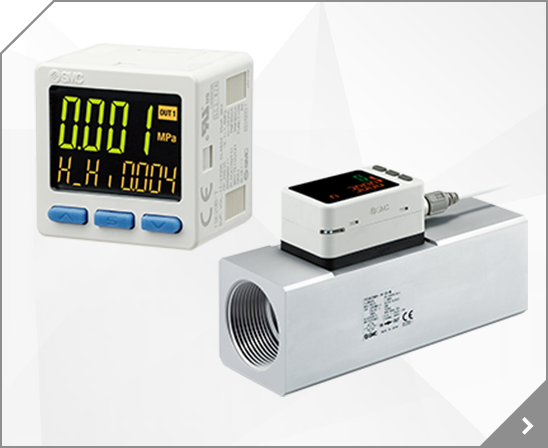


 Series PF2W Digital Flow Switch For Water Refer to www. poweraire .com for details of products compatible with overseas standards.
 acceleration, whichever is smaller. 4.9 m/s2 Vibration resistance 490 m/s2 in X, Y, Z directions 3 times each Impact resistance Noise resistance 1000 Vp-p, Pulse width 1 s, Rise time 1 ns Weight Note 3) 410 g 470 g 650 g 1,100 g Port size (Rc, NPT, G) 3/8 3/8, 1/2 1/2, 3/4 3/4, 1 Note 1) The system accuracy when combined with PF2W2/3.
Material N N B R S Silicone rubber u urethane rubber F Fluorine rubber GN Conductive NBR (s2-o 16) GS Conductive silicone (s2-o16) Material N N B R s silicone rubber u _ urethane rubber F Ftuorine rubber GN Conductive NBR (o2-o16\ GS Conductive silicone (@2-@'16) Pad type (application: Refer to list O) U Flat type c Ftat with rib D Deep type B Bellows type Pad type U Flat type c _ Flat vYith
Material N N B R S Silicone rubber u urethane rubber F Fluorine rubber GN Conductive NBR (s2-o 16) GS Conductive silicone (s2-o16) Material N N B R s silicone rubber u _ urethane rubber F Ftuorine rubber GN Conductive NBR (o2-o16\ GS Conductive silicone (@2-@'16) Pad type (application: Refer to list O) U Flat type c Ftat with rib D Deep type B Bellows type Pad type U Flat type c _ Flat vYith
L : Stroke [mm] (Operating condition) V : Speed [mm/s] (Operating condition) a1: Acceleration [mm/s2] (Operating condition) a2: Deceleration [mm/s2] (Operating condition) T2 = [s] L 0.5 V (T1 + T3) V T4: Settling time varies depending on the conditions such as motor types, load and in position of the step data.
CDRBU2W10, 15-S CDRBU2W20, 30-S CRB2 CRBU2 CRB1 2 x S2 2 x S1 2 x S1 MSU 2 x S2 CRJ Rotary actuator CRA1 CRQ2 2 x S1 2 x S1 2 x S1 2 x S1 Rotary actuator MSQ (34.5: Connector type) MSZ A port B port CRQ2X MSQX 2 x R A port B port 2 x R MRQ 1 Auto switch Auto switch 2 5 20.5 (26.5: Connector type) 1.
R1 R2 SG FG 24 V 0 V S1 S2 SG 24 V 0 V S1 S2 R1 R2 SG FG 24 V 0 V S1 S2 R1 R2 SG FG 24 V 0 V Ground either the reception side or the transmission side of the shielding wire shield.
The setting range is 1 to 60,000 mm/s2. The acceleration can be entered when the [Speed Entry Method] has been selected in the [Step Data Input Method] in the Basic Parameter Set up window. The Acceleration can be set in increments of 1 mm/s2. 65 - g) Decel Set the deceleration required from [Speed] to stop. The setting range is 1 to 60,000 mm/s2.
S1 S2 S1 S2 S1 S2 S1 Master unit V BDH SD FG SD FG SD FG SD FG CANL Twisted pair wire with shield FG BDL Class 3 ground Class 3 ground Class 3 ground Class 3 ground CANH V+ Connect the shielding wire to the SD terminal.
Insulation resistance 10 to 500 Hz with a 1.5 mm amplitude or 98 m/s2 acceleration, whichever is smaller. Vibration resistance 490 m/s2 in X, Y, Z directions 3 times each Impact resistance 1000 Vp-p, Pulse width 1 s, Rise time 1 ns Noise resistance 200 g 240 g Weight Note 3) Port size (Rc, NPT, G) 1/8, 1/4 3/8 1/2 Note 1) The system accuracy when combined with PF2A2/3.
Kit/Electrical entry/Cable length F P Kit (Dsub connector) Kit (Flat cable connector) Connector location Top (vertical) Side (horizontal) Connector location Top (vertical) Side (horizontal) P .1.10-40 P .1.10-36 Without cable Without cable S0 S1 S2 S3 S0 S1 S2 S3 U0 U1 U2 U3 U0 U1 U2 U3 stations Max.16 (2) Max.16 (2) F kit P kit P kit F kit With cable (1.5m) With cable (3m) With cable (5m
P1 LED lever meter Sensor S1 S3 Red is on: Output OFF Green is on: Output ON S4 S2 + P2 Red 1 Gap too big S1, S2: Fixed orifice S3: Variable orifice (Set via adjustment knob) S4: Detection nozzle Red 2 Green 1 BEST POSITION The bridge circuit is constructed as shown in the diagram. Position the work piece in front of the nozzle (S4).
Maximum acceleration: 2000mm/s2 Positioning distance (mm) 1 1000 500 100 10 10 0.5 100.5 50.5 10.5 1.5 100 0.5 10.5 5.5 1.5 0.6 Speed (mm/s) 500 0.5 2.7 1.7 0.9 0.6 1000 0.5 1.9 1.4 0.9 0.6 A B C D Values will vary slightly depending on the operating conditions.
Impact/Vibration resistance (m/s2) Note) 150/50 Enclosure Dustproof Note) Impact resistance: No malfunction from test using drop impact tester, to axis and right angle directions of main valve, each one time when pilot signal ON and OFF.
Address Description of bytes tion unit range Input Mode D0410 4 Target position [m] Note 1) 1 Note 1) No D0412 2 Positioning time [0.01s] 1 0 to 6000 No D0413 2 Speed [mm/s] 1 0 to 400 No D0414 2 Acceleration [mm/s2] 1 0 to 60 No D0415 2 Deceleration [mm/s2] 1 0 to 60 No 1 to 20, Pushing speed [mm/s] D0416 2 1 No 32768 to Note2) 32788 Thrust setting value Note 3) More than D0417 2 1 Yes [
External terminals (including the FE terminal) and enclosure screws Insulation resistance 10 M or more 500 VDC External terminals (including the FE terminal) and enclosure screws EN61131-2 compliant 5f<8.4 Hz 3.5 mm Vibration resistance 8.4f<150 Hz 9.8 m/s2 Impact resistance EN61131-2 compliant, 147 m/s2, 11 ms Mounting Through hole for M4 screw (2 pcs.)
without control unit and bracket mounted, Others 30 m/s2, whichever is smaller for 2 hours in X, Y, Z direction each (De-energized) Vibration resistance Without control unit and bracket mounted: 980 m/s2, Others: 150 m/s2 in X, Y and Z direction, 3 times each (De-energized) Nil: Rc 1/8, N type: NPT 1/8, F type: G 1/8 4-core, oil resistant, cable (0.64 mm2) with M12, 4-pin pre-wired connector
Movement Load : Angular acceleration F: Pressing force (N) T f = F x l (Nm) . 2 = (rad/s 2) Load Static torque calculation t 2 g = 9.8 m/s2 Ts = F x l (Nm) l : Rotation angle (rad) Lever t : Rotation time (S) Axis Rotary actuator Axis Allowable Load Application of the load on the axial direction is tolerated if no dynamic load is generated and the values are within what is shown in the
Static torque calculation Tf = F x L (Nm) Load . g = 9.8m/s2 F: Pressing force (N) : Angular acceleration Load .
Movement Load : Angular acceleration F: Pressing force (N) T f = F x l (Nm) . 2 = (rad/s 2) Load Static torque calculation t 2 g = 9.8 m/s2 Ts = F x l (Nm) l : Rotation angle (rad) Lever t : Rotation time (S) Axis Rotary actuator Axis Allowable Load Application of the load on the axial direction is tolerated if no dynamic load is generated and the values are within what is shown in the
Movement Load : Angular acceleration F: Pressing force (N) T f = F x l (Nm) . 2 = (rad/s 2) Load Static torque calculation t 2 g = 9.8 m/s2 Ts = F x l (Nm) l : Rotation angle (rad) Lever t : Rotation time (S) Axis Rotary actuator Axis Allowable Load Application of the load on the axial direction is tolerated if no dynamic load is generated and the values are within what is shown in the