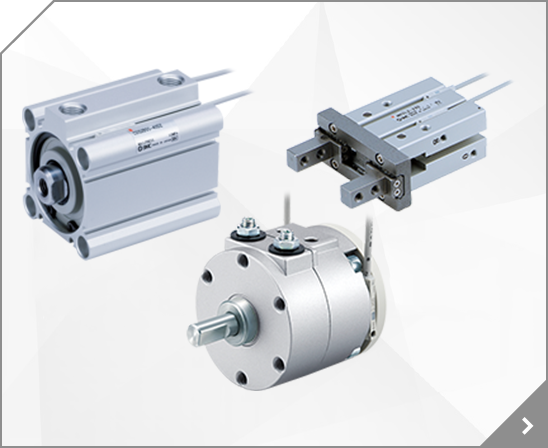


 Auto Switch Guide Reed Switches/Solid State Switches For Rotary Actuators (Air Grippers) 1
 Do not drop, bump, or apply excessive impacts (300 m/s2 or more for reed switches and 1000 m/s2 or more for solid state switches) while handling. Although the body of the switch may not be damaged, the inside of the switch could be damaged and cause a malfunction. 2. Do not carry a cylinder by the auto switch lead wires. Never carry a cylinder by its lead wires.
Movement Load : Angular acceleration F: Pressing force (N) T f = F x l (Nm) . 2 = (rad/s 2) Load Static torque calculation t 2 g = 9.8 m/s2 Ts = F x l (Nm) l : Rotation angle (rad) Lever t : Rotation time (S) Axis Rotary actuator Axis Allowable Load Application of the load on the axial direction is tolerated if no dynamic load is generated and the values are within what is shown in the
Movement Load : Angular acceleration F: Pressing force (N) T f = F x l (Nm) . 2 = (rad/s 2) Load Static torque calculation t 2 g = 9.8 m/s2 Ts = F x l (Nm) l : Rotation angle (rad) Lever t : Rotation time (S) Axis Rotary actuator Axis Allowable Load Application of the load on the axial direction is tolerated if no dynamic load is generated and the values are within what is shown in the
Do not drop, bump, or apply excessive impacts (300 m/s2 or more for reed switches and 1000 m/s2 or more for solid state switches) while handling. Although the body of the switch may not be damaged, the inside of the switch could be damaged and cause a malfunction. 2. Do not carry a cylinder by the auto switch lead wires. Never carry a cylinder by its lead wires.
Do not drop, bump, or apply excessive impacts (300 m/s2 or more for reed switches and 1000 m/s2 or more for solid state switches) while handling. Although the body of the switch may not be damaged, the inside of the switch could be damaged and cause a malfunction. 2. Do not carry a cylinder by the auto switch lead wires. Never carry a cylinder by its lead wires.
Do not drop, bump, or apply excessive impacts (300 m/s2 or more for reed switches and 1000 m/s2 or more for solid state switches) while handling. Although the body of the switch may not be damaged, the inside of the switch could be damaged and cause a malfunction. 2. Do not carry a cylinder by the auto switch lead wires. Never carry a cylinder by its lead wires.
Do not drop, bump, or apply excessive impacts (300 m/s2 or more for reed switches and 1000 m/s2 or more for solid state switches) while handling. Although the body of the switch may not be damaged, the inside of the switch could be damaged and cause a malfunction. 2. Do not carry a cylinder by the auto switch lead wires. Never carry a cylinder by its lead wires.
Do not drop, bump, or apply excessive impacts (300 m/s2 or more for reed switches and 1000 m/s2 or more for solid state switches) while handling. Although the body of the switch may not be damaged, the inside of the switch could be damaged and cause a malfunction. 2. Do not carry a cylinder by the auto switch lead wires. Never carry a cylinder by its lead wires.
Do not drop, bump, or apply excessive impacts (300 m/s2 or more for reed switches and 1000 m/s2 or more for solid state switches) while handling. Although the body of the switch may not be damaged, the inside of the switch could be damaged and cause a malfunction. 2. Do not carry a cylinder by the auto switch lead wires. Never carry a cylinder by its lead wires.
Do not drop, bump, or apply excessive impacts (300 m/s2 or more for reed switches and 1000 m/s2 or more for solid state switches) while handling. Although the body of the switch may not be damaged, the inside of the switch could be damaged and cause a malfunction. 2. Do not carry a cylinder by the auto switch lead wires. Never carry a cylinder by its lead wires.
Do not drop, bump, or apply excessive impacts (300 m/s2 or more for reed switches and 1000 m/s2 or more for solid state switches) while handling. Although the body of the switch may not be damaged, the inside of the switch could be damaged and cause a malfunction. 2. Do not carry a cylinder by the auto switch lead wires. Never carry a cylinder by its lead wires.
Do not drop, bump, or apply excessive impacts (300 m/s2 or more for reed switches and 1000 m/s2 or more for solid state switches) while handling. Although the body of the switch may not be damaged, the inside of the switch could be damaged and cause a malfunction. 2. Do not carry a cylinder by the auto switch lead wires. Never carry a cylinder by its lead wires.
Temperature abnormality On 16 Series E-MY2 Auto Switch Specifications Auto Switch Common Specifications Reed switch Solid state switch Type Leakage current 3-wire: 100 A or less 2-wire: 0.8 mA or less None Operating time 1.2 ms 1 ms or less 300 m/s2 1000 m/s2 Impact resistance 50 M or more at 500 VDC Mega (between lead wire and case) Insulation resistance Withstand voltage 1000 VAC for 1
Mount switches in locations where there is no vibration greater than 98 m/s2, or no impact greater than 490 m/s2. 3. Do not use in an area where surges are generated.
Do not drop, bump, or apply excessive impact (PSE540: 980 m/s2, PSE560: 500 m/s2) while handling. Although the body of the sensor may not be damaged, the inside of the sensor could be damaged and lead to malfunction. 2. The tensile strength of the cord is 50 N. Applying a greater pulling force to it can cause malfunction.
specifications Coil specifications Seal material NBR, FKM, EPDM, PTFE Ambient temperature (C) 20 to 60 1 to 60 (No freezing) Fluid temperature (C) VC Dusttight/low jetproof (equivalent to IP65) Enclosure VDW Environment Location without corrosive or explosive gases (3) Valve leakage (cm3/min) 0 (With water pressure) VQ Mounting orientation Unrestricted (4) Vibration/Impact resistance (m/s2
Size: 80D [11 m³/min (ANR)], Thread: N (NPT), Port Size: 14 (1 1/2), Option: H (Medium Pressure with Auto Drain, 1.6 MPa), Bracket: B (Bracket)
Rated Flow Range: 06 (60 to 6000 l/min), Thread Type: N (NPT), Port Size: 14 (1 1/2), Output Specification: L4 [Out: IO-Link, Switch Output (N/P); Func: Analog Current Output <-> External Input; Monitor Unit Model: PFG310 Series], Lead Wire: Q (Lead Wire and M12-M12 Connector, 3m), Unit Specification: M (SI Unit Only), Calibration Certificate: A (Made to Order)
Rated Flow Range: 21 (50 to 250 L/min), Flow Adjustment Valve: None, Thread: N (NPT), Port Size: 14 (1 1/2), Output Specification: F (OUT1: PNP; OUT2: Analog 4 to 20mA), Temperature Sensor: None, Lead Wire: Lead Wire w/M8 Connector, 3m, Unit Specification: F (Instantaneous Flow Rate: Gal/min; Accumulated Flow: Gal; Temp: °F), Bracket: None, Calibration Certificate: A (Calibration Certificate
Size: 70D [7 m³/min (ANR)], Thread: N (NPT), Port Size: 14 (1 1/2), Option: H (Medium Pressure with Auto Drain, 1.6 MPa), Bracket: B (Bracket)