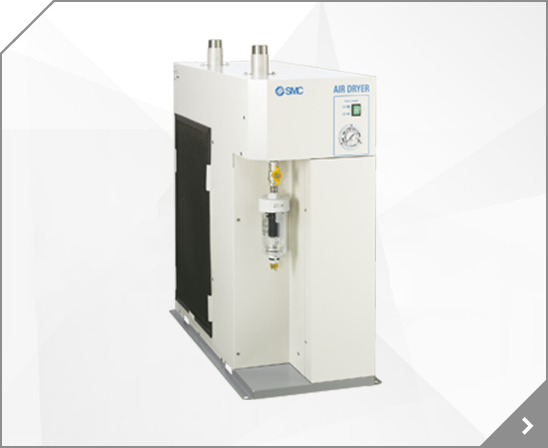
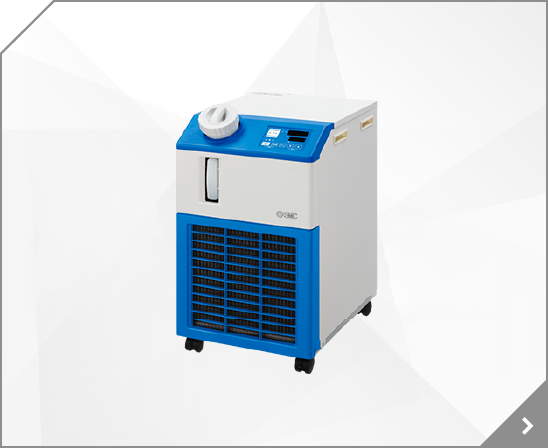


 Refrigerated Air Dryers
 Applicable air dryer Capacity Type Inlet voltage Outlet voltage A B C D E F Weight IDF-TR500-3 IDF1E-10 to 8E-10 IDU3E-10, 4E-10, 8E-10 500 VA 380, 400, 415 VAC (50 Hz) 380 to 420 VAC (60 Hz) 100 VAC (50 Hz) 110 VAC (60 Hz) 15 kg IDF-TR1000-3 IDF11E-10, 15E1-10 IDU6E-10, 11E-10, 15E1-10 1 kVA Singlephase Singleturn 230 207 190 210 160 9 IDF-TR500-4 IDF1E-10 to 8E-10 IDU3E-10, 4E-10, 8E-10
Inch size Millimeter size Port size 5/32 04 03 4 M5 M5 x 0.8 Thread type 1/4 06 07 6 U10/32 10-32UNF 5/16 08 09 8 Metric system thread (M5) 01 1/8 3/8 10 11 10 Nil Unified thread (10-32UNF) 02 1/4 1/2 12 13 12 Rc(PT) 03 3/8 N NPT 04 1/2 Check valve free flow direction Applicable Tube O.D.
Do not drop or bump. Do not drop, bump, or apply excessive impacts (300 m/s2 or more for reed switches and 1000 m/s2 or more for solid state switches) while handling. Although the body of the switch may not be damaged, the inside of the switch could be damaged and cause a malfunction. 2. Do not carry a cylinder by the auto switch lead wires. Never carry a cylinder by its lead wires.
(Do not tighten with pliers.)
They do not guarantee an actual fixed range (expect approximately 30% dispersion).
Do not operate beyond the rated voltage range. If applying voltage over the rated voltage range, equipment may be damaged. 2. Avoid incorrect wiring such as polarity of power supply. Otherwise, equipment may be damaged. 3. Do not short circuit the load. (Do not connect to power supply.) Otherwise, equipment may be damaged.
Outlet air atmospheric pressure dew point C P1 = 0.5MPa P1 = 0.5MPa 10 10 20 20 P1 = 0.7MPa P1 = 0.7MPa 30 30 40 40 0 40 80 120 160 20 40 60 80 0 Outlet air flow rate l/min (ANR) Outlet air flow rate l/min (ANR) IDG20 IDG30 P1 = 0.3MPa P1 = 0.3MPa 0 0 Outlet air atmospheric pressure dew point C Outlet air atmospheric pressure dew point C P1 = 0.5MPa 10 P1 = 0.5MPa 10 P1 = 0.7MPa 20 20 P1
Do not drop or bump. Do not drop, bump, or apply excessive impacts (300 m/s2 or more for reed switches and 1000 m/s2 or more for solid state switches) while handling. Although the body of the switch may not be damaged, the inside of the switch could be damaged and cause a malfunction. 2. Do not carry a cylinder by the auto switch lead wires. Never carry a cylinder by its lead wires.
Do not drop or bump. Do not drop, bump, or apply excessive impacts (300 m/s2 or more for reed switches and 1000 m/s2 or more for solid state switches) while handling. Although the body of the switch may not be damaged, the inside of the switch could be damaged and cause a malfunction. 2. Do not carry a cylinder by the auto switch lead wires. Never carry a cylinder by its lead wires.
Do not drop or bump. Do not drop, bump, or apply excessive impacts (300 m/s2 or more for reed switches and 1000 m/s2 or more for solid state switches) while handling. Although the body of the switch may not be damaged, the inside of the switch could be damaged and cause a malfunction. 2. Do not carry a cylinder by the auto switch lead wires. Never carry a cylinder by its lead wires.
Do not drop or bump. Do not drop, bump, or apply excessive impacts (300 m/s2 or more for reed switches and 1000 m/s2 or more for solid state switches) while handling. Although the body of the switch may not be damaged, the inside of the switch could be damaged and cause a malfunction. 2. Do not carry a cylinder by the auto switch lead wires. Never carry a cylinder by its lead wires.
Furthermore, do not allow excessive force to be applied to the lines. 2. Use electrical circuits which do not generate chattering in their contacts. 3. Use voltage which is within 10% of the rated voltage. In cases with a DC power supply where importance is placed on responsiveness, stay within 5% of the rated value.
10 0 0 10 30 40 50 20 60 10 20 Discharge rate l/min Discharge rate l/min Selection from flow rate characteristic graphs (PA3000) Required specification example: 3.
to 40 39.5 31.5 6 6 29 5.5 10 38 5 8 20 3.5 6.5 M6 x 1.0 7 18 10 5 M4 x 0.7 10 to 60 44 34 8 8 36 5.5 16 47 7 10 25.5 5.4 9 M6 x 1.0 7 19.5 10 6 M5 x 0.8 10 to 60 47.5 37.5 10 10 40 5.5 20 52 8 10 28 5.4 9 M6 x 1.0 7 23 10 49.5 7 M6 x 1.0 10 to 50, 75, 100 54 42 12 12 45 8.5 25 60 4.5 10 12 34 5.5 9 M6 x 1.0 7 26 10 57 10 M8 x 1.25 10 to 50, 75, 100 60.5 48.5 13 16 52 8.5 28 69 5 14
0.06 ST 15, 20 0.04 0.04 ST 15, 20 0.04 ST 5, 10 0.02 0.02 0.02 ST 5, 10 0.00 0 5 10 15 0.00 0 5 10 15 0.00 0 5 10 15 Load [N] Load [N] Load [N] MXZ16 MXZ16 MXZ16 0.15 0.15 0.15 Table displacement [mm] Table displacement [mm] Table displacement [mm] ST 25, 30 ST 25, 30 ST 25, 30 ST 15, 20 0.10 0.10 0.10 ST 15, 20 ST 15, 20 ST 5, 10 0.05 0.05 0.05 ST 5, 10 ST 5, 10 0.00 0 5 10 15 20 25 0.00
DO NOT COPYWTIHOUTWRMTENPERMISSION 2 5 P i t E U A T l c T E c H N o L o c Y A I R D R Y E R S Aftercoolers cool the air to within 10-1soc of the cooling medium. The conlrol and operating elements ot th pneumatic system will normally be al ambient temperature (approx. 20cC).
Environment Warning 1.Do not expose the product to direct sunlight for an extended period of time. 2.Do not use in a place subject to heavy vibration and/or shock. 3.Do not mount the product in locations where it is exposed to radiant heat. 4.
UPPER AND LOWER LIMIT ARISES -9-2 FIG. 10-1 MOISTURE AIR DIAGRAM -10-3 vi Contents Table List Page No.